The phrase ‘I Am’ is one of the most fundamental and profound expressions in human language. It represents the essence of self-awareness, encapsulating our consciousness, identity, and sense of existence. Yet, within the simplicity of these two words lies a profound paradox that has intrigued philosophers, spiritual seekers, and thinkers for centuries. In this blog, we embark on a journey to explore the paradox of ‘I Am,’ delving into its depths and complexities.
The Essence of ‘I Am’

- The Root of Self-Awareness: ‘I Am’ is the foundational statement of self-awareness. It signifies our subjective experience of existence, the knowledge that we are, and the anchor of our identity.
- The Inner Observer: It introduces us to the concept of the inner observer—an entity that is capable of observing thoughts, emotions, and experiences. ‘I Am’ is not just a thought; it is the thinker behind the thought.
- The Continuous Presence: From the moment we gain consciousness as infants, the sense of ‘I Am’ is present. It accompanies us throughout our waking hours, forming the basis of our understanding of the world and our place within it.
The Paradox of ‘I Am’

- The Self-Reflective Paradox: The paradox of ‘I Am’ emerges when we contemplate the nature of the thinker behind the thought. In asking, “Who am I?” or “What is the nature of ‘I Am’?” we enter a realm of self-reflection that can lead to an infinite regress.
- The Subject-Object Duality: ‘I Am’ implies a subject—an observer—and an object—the observed. However, this distinction can blur in deep meditative states or moments of profound insight, challenging the conventional boundaries of self and other.
- The Ego and Beyond: The ego, often associated with the ‘I Am’ identity, can lead to a sense of separation and individuality. Yet, spiritual traditions and philosophies often point to a transcendent ‘I Am’ that goes beyond the limitations of ego.
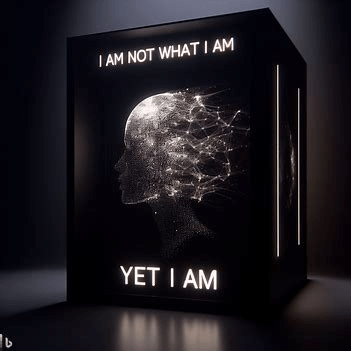
Bing image generator: “The Pardox of ‘I Am’“
Exploring the Paradox

- Philosophical Inquiry: Philosophers such as René Descartes (“I think, therefore I am”) and Immanuel Kant delved into the nature of ‘I Am’ and self-awareness, contributing to our understanding of the paradox.
- Spiritual Wisdom: Spiritual traditions, including Buddhism and Advaita Vedanta, offer insights into the paradox by emphasizing the illusion of the separate self and the quest for realizing a unified ‘I Am’ that transcends ego.
- The Quest for Self-Knowledge: For individuals, the paradox of ‘I Am’ can be a lifelong journey of self-discovery. It involves contemplation, meditation, and inner inquiry to explore the depths of self-awareness.
Being as Being

bing image genrator: “Rest In Being“
The paradox of ‘I Am’ invites us to venture into the heart of self-awareness and consciousness. It challenges our assumptions about identity, ego, and the nature of reality. While it may remain a paradox that eludes complete intellectual understanding, it serves as a profound reminder of the depth and complexity of the human experience.
As we navigate the intricacies of ‘I Am,’ we embark on a journey of self-discovery and philosophical inquiry. It is a journey that encourages us to question our assumptions, explore the boundaries of consciousness, and contemplate the profound mystery of existence itself.
article prompt engineuro: OpenAI
other images, Bing image generator: “The Paradox of ‘I Am'”
Stay in the NOW with Inner I Network;

 Inner I Net Company/ - Innovative Solutions to Shape Reality