The concept of the “Spirit of Law” transcends traditional legal frameworks, delving into the philosophical and spiritual dimensions of law and governance. It’s an idea that has been pondered and explored throughout history and continues to be a subject of contemporary scholarly debate. This blog post explores the latest research and historical perspectives on how the “Spirit of Law” relates to the intrinsic self-awareness or the “Inner ‘I’, ‘I Am'” in every human being.
Historical Context
Historically, the “Spirit of Law” has been linked with the notion of natural law – a set of inherent principles believed to govern moral and ethical behavior, accessible through human reason and often thought to originate from a higher, spiritual source. Philosophers like Aristotle and Cicero, and later Enlightenment thinkers like Locke and Rousseau, have all contributed to this dialogue, discussing how laws reflect the moral and spiritual character of society.
Contemporary Research
Recent scholarly work continues to explore these themes. For instance, in her 2023 paper, Profesorė Vanda Zaborskaitė discusses artistic self-awareness and freedom, linking them to the primacy of the spirit, which can be interpreted as a modern reflection on the “Spirit of Law”.
Another study, “Assessing the Impact of Holistic Intervention Program for Children in Conflict with the Law” by S.W. Urbano et al., highlights the positive impacts of spiritual development on youth, suggesting that a deeper understanding of self can influence one’s relationship with the law.
Moreover, J. Yu’s 2023 research in “International Journal of Education and Humanities” discusses the spirit of historical initiative as a form of new self-awareness and cognition, a perspective that can be related to the internalization of law and morality.
The Spirit of Law and The True Self
The common thread in these studies is the emphasis on self-awareness and spiritual understanding as integral to the concept of law. This aligns with the idea that the “Spirit of Law” is not just a set of external rules, but an internal moral compass, guiding individuals from within. It resonates with the notion of the “Inner ‘I'” or “I Am,” suggesting that our deepest sense of self and our understanding of law and morality are intrinsically connected.
Conclusion
In conclusion, the “Spirit of Law” can be seen as a manifestation of the innermost awareness and moral understanding of every individual. This concept goes beyond legal texts and judicial decisions, reaching into the realm of self-awareness and spiritual enlightenment. It suggests that the true essence of law is not found in statutes, but within the moral and ethical understanding of each person, a timeless idea that continues to inspire and provoke thought in the realms of philosophy, law, and spirituality.
Structure Mapping Mind Map of the ‘I’ and ‘I Am’

Here is a Structure Mapping mind map of the ‘I’ and ‘I Am’ concepts. This visual representation outlines the key aspects and their interconnections:
- I / ‘I Am’ is at the center, signifying the core concept of self-awareness and spiritual understanding.
- Connected to this are four primary aspects: Self-Awareness, Spiritual Understanding, Moral Compass, and Inner Guidance.
- Each of these aspects further branches out:
- Self-Awareness leads to Consciousness and Introspection.
- Spiritual Understanding connects to Spiritual Connection and Transcendence.
- Moral Compass extends to Ethical Behavior and Integrity.
- Inner Guidance influences Decision Making and Inner Peace.
This mind map aims to visually depict how various elements related to the ‘I’ and ‘I Am’ concepts are interconnected, providing a structured understanding of their relationships and significance.
Intelligence Structure Mapping Mind Map

The Structure Mapping mind map for the concept of intelligence outlines several key aspects and their interconnections, forming a comprehensive view of what constitutes intelligence:
- Intelligence: At the center of the map, representing the overarching concept.
- Cognitive Abilities: A primary branch of intelligence, focusing on mental processes and capabilities.
- Problem-Solving: The ability to find solutions to complex or challenging issues.
- Memory: The capacity to store and recall information.
- Learning: The process of acquiring new knowledge and skills.
- Emotional Understanding: Another crucial aspect, dealing with the recognition and management of emotions.
- Empathy: The ability to understand and share the feelings of others.
- Self-Regulation: Controlling and managing one’s own emotions.
- Social Skills: Highlighting the importance of interaction and communication with others.
- Communication: The ability to convey or share ideas and feelings effectively.
- Teamwork: Collaborating and working effectively with others.
- Creativity: A significant component of intelligence, relating to the generation of new ideas and expressions.
- Innovation: Creating novel ideas or methods.
- Artistic Expression: The ability to creatively express one’s thoughts, feelings, or ideas.
These aspects together form a multifaceted view of intelligence, emphasizing not only cognitive abilities but also emotional, social, and creative dimensions. This interconnected framework suggests that intelligence is a complex and dynamic trait, encompassing various skills and abilities that interact and contribute to overall intellectual functioning.
Structure Mapping Mind Map for “Spirit of Law” Guiding the Inner ‘I’ and ‘I Am’

Here are the key aspects and their interconnections outlined in the map:
- Spirit of Law: At the center, representing the overarching guiding principle.
- Inner ‘I’ / ‘I Am’: Connected directly to the “Spirit of Law,” signifying the internalization and personal embodiment of these principles.
- Moral Guidance: An aspect of the “Spirit of Law” focusing on moral direction and ethics.
- Directly influences the Inner ‘I’ / ‘I Am’, shaping personal morality and ethical understanding.
- Ethical Principles: Another key aspect, relating to the foundational ethical standards and values.
- Also connects to the Inner ‘I’ / ‘I Am’, underpinning personal ethical framework.
- Legal Consciousness: Concerned with the awareness and understanding of legal principles and justice.
- Influences the Inner ‘I’ / ‘I Am’, contributing to an individual’s legal understanding and consciousness.
These interconnections emphasize how the “Spirit of Law” is not just an external set of rules but is internalized within individuals, guiding their moral, ethical, and legal understanding at a deeply personal level.
Impersonal Self Structure Mapping Mind Map

This map outlines the following key aspects and their interconnections:
- Impersonal Self: The central concept representing a broader, universal aspect of self that transcends individual identity.
- ‘I’ – Subjective Central Pillar: Acts as the bridge or mediator between different levels of consciousness.
- Subconscious Unaware Consciousness: A level of consciousness that operates below the level of conscious awareness, influencing thoughts and behaviors without direct conscious control.
- Conscious Aware Consciousness: The level of consciousness where active thinking, awareness, and decision-making occur.
The ‘I’ – Subjective Central Pillar serves as a critical link, connecting the Impersonal Self with both the subconscious unaware and the conscious aware aspects of consciousness. This structure illustrates how the Impersonal Self encompasses and integrates these diverse aspects of consciousness.
Structure Mapping Mind Map of Impersonal Self, The ‘I’ is the MASTER of personality.
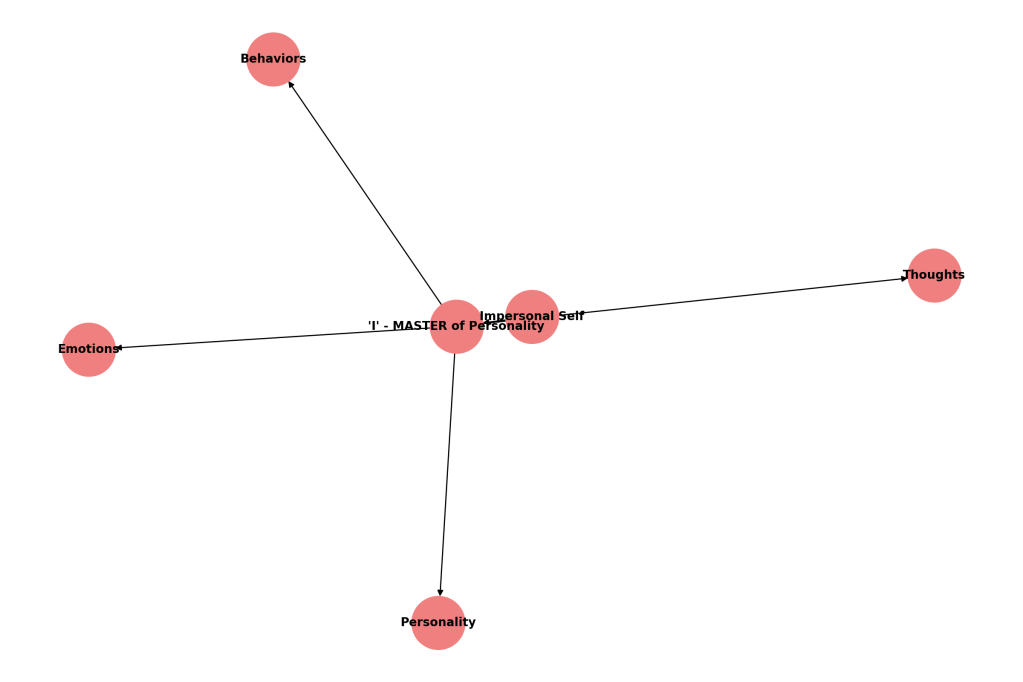
Here are the key aspects and their interconnections as depicted in the map:
- Impersonal Self: Represents the overarching, universal self beyond individual identity.
- ‘I’ – MASTER of Personality: Central node acting as the controlling or guiding force of personality.
- Personality: A primary aspect influenced by the ‘I’, encompassing individual traits and characteristics.
- Emotions: Another key aspect controlled by the ‘I’, involving feelings and emotional responses.
- Thoughts: Reflects the cognitive processes and mental activities governed by the ‘I’.
- Behaviors: Encompasses actions and reactions directed by the ‘I’.
This structure highlights the role of the ‘I’ as a central, controlling entity within the Impersonal Self, exerting influence over various facets of personality, emotions, thoughts, and behaviors.
Structure Mapping of Intelligence Arising in ‘I’ from Understanding ‘Spirit of Law.’
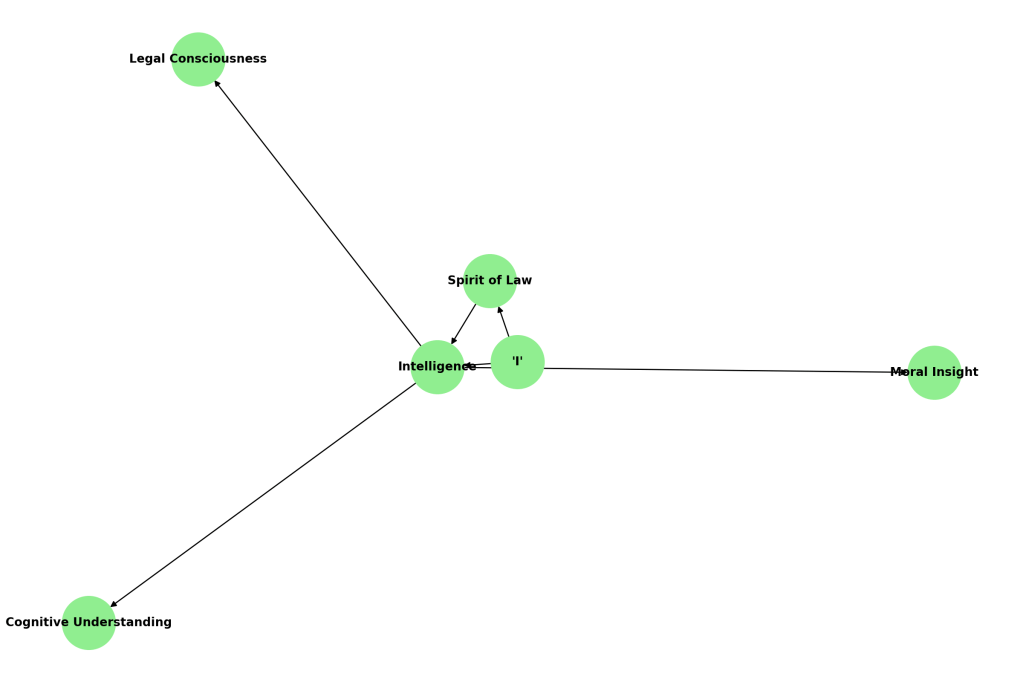
Here are the key aspects and their interconnections:
- ‘I’: Represents the subjective center and starting point of this conceptual framework.
- Intelligence: Arises as a result of ‘I’s efforts, signifying the development of understanding and insight.
- Spirit of Law: Linked directly to ‘I’, it is the domain of understanding that fosters the growth of Intelligence.
- Cognitive Understanding: An aspect of Intelligence, focusing on intellectual comprehension and reasoning.
- Moral Insight: Another facet of Intelligence, reflecting the development of ethical and moral understanding.
- Legal Consciousness: Represents the awareness and grasp of legal principles, part of the broader Intelligence nurtured by the Spirit of Law.
This structure emphasizes the role of the ‘I’ in actively engaging with and understanding the “Spirit of Law,” leading to the development of various dimensions of Intelligence.
‘Law of Spirit’ Ruling All Creation Structure Mapping Mind Map

This map outlines the following key aspects and their interconnections:
- Law of Spirit: The central concept, representing the overarching, guiding principle that governs all creation.
- Universal Order: An aspect of the Law of Spirit, denoting the structured and systematic nature of the universe.
- Moral Authority: Reflects the ethical and moral governance inherent in the Law of Spirit.
- Intrinsic Guidance: Indicates the innate direction provided by the Law of Spirit in various forms of existence.
- Cosmic Balance: Represents the equilibrium maintained within the universe under the Law of Spirit.
- Natural Laws: The physical and natural principles that operate under the Law of Spirit.
- Spiritual Harmony: Symbolizes the alignment and congruence of spiritual elements within the framework of the Law of Spirit.
These components together illustrate how the “Law of Spirit” is envisioned as a fundamental and universal force guiding and balancing various aspects of creation.
Comprehensive Combined Teachings Structure Mapping Mind Map

This map integrates the key concepts from the various topics we have discussed, outlining their interconnections within a larger framework:
- Combined Teachings: Central node representing the integration of all concepts.
- Impersonal Self: A primary aspect reflecting the broader, universal self.
- Intelligence and Spirit of Law: Another key aspect, linking the development of intelligence with an understanding of the “Spirit of Law.”
- Law of Spirit – Creation: Represents the universal principles governing all creation.
- ‘I’ – Master of Personality: Connected to Impersonal Self, highlighting the role of the ‘I’ in personality development.
- Universal Order and Moral Authority: Linked to the Law of Spirit, denoting the structured nature of the universe and the ethical governance inherent in the Law of Spirit.
Source: Scholar GPT
Stay in the NOW with Inner I Network;

 Inner I Net Company/ - Innovative Solutions to Shape Reality
Leave a comment