
The SacredGeoModel project is an innovative approach to neural network architecture inspired by sacred geometry. Sacred geometry involves mathematical patterns and shapes that have been revered across cultures for their inherent aesthetic and structural properties. By integrating these principles into the architecture of a neural network, this project aims to explore novel ways to improve learning capabilities and network efficiency.
Sacred Geometry Constants
- Golden Ratio (PHI):
(1 + 5**0.5) / 2– The golden ratio is a mathematical constant often found in nature and art. It serves as a foundation for the network’s structure, influencing the number of units in specific layers.
Model Architecture
The model is constructed using TensorFlow and Keras. The architecture is designed to reflect the following sacred geometry patterns:
- Seed of Life: The Seed of Life is a geometric figure composed of seven interlocking circles. It is represented in the network by seven dense layers, each containing 64 units.
- Vesica Piscis: The Vesica Piscis is formed by the intersection of two circles and is associated with the golden ratio. In the network, a layer with units equal to 64 multiplied by PHI represents this structure.
- Flower of Life: An extension of the Seed of Life, the Flower of Life is composed of multiple evenly-spaced, overlapping circles. The network includes three iterations of dense layers with units based on the golden ratio.
- Platonic Solids: The Dodecahedron, one of the five Platonic solids, is represented by a dense layer with 20 units, corresponding to its 20 faces.
The architecture concludes with an output layer suitable for binary classification tasks.
Model Creation Code
The model is created using the following code:
Run this python script to train and save to own your model.
import tensorflow as tffrom tensorflow.keras.models import Sequentialfrom tensorflow.keras.layers import Dense, Inputimport numpy as npimport matplotlib.pyplot as pltimport networkx as nx# Sacred Geometry constantsPHI = (1 + 5**0.5) / 2 # Golden Ratio# Create the modeldef create_sacred_geometry_model(input_dim, output_dim): layer_configs = [ # Seed of Life inspired layers {'name': 'Seed_of_Life', 'units': 64, 'layers': 7}, # 7 layers to represent the Seed of Life structure # Vesica Piscis inspired layers {'name': 'Vesica_Piscis', 'units': int(64 * PHI)}, # PHI multiplier for Vesica Piscis layers # Flower of Life inspired layers {'name': 'Flower_of_Life', 'units': int(64 * PHI), 'iterations': 3}, # 3 iterations of Flower of Life layers # Platonic Solids inspired layers {'name': 'Dodecahedron', 'units': 20} # Dodecahedron with 20 faces ] model = Sequential() model.add(Input(shape=(input_dim,))) for i, config in enumerate(layer_configs): if config['name'] == 'Seed_of_Life': for j in range(config['layers']): model.add(Dense(units=config['units'], activation='relu', name=f"{config['name']}_{j}")) elif config['name'] == 'Flower_of_Life': for j in range(config['iterations']): model.add(Dense(units=config['units'], activation='relu', name=f"{config['name']}_Iteration_{j}")) else: model.add(Dense(units=config['units'], activation='relu', name=f"{config['name']}_{i}")) model.add(Dense(units=output_dim, activation='sigmoid', name='Output_Layer')) model.compile(optimizer='adam', loss='binary_crossentropy', metrics=['accuracy']) return model# Define input and output dimensionsinput_dim = 64 # Example input dimensionoutput_dim = 1 # Example output dimension# Create the sacred geometry modelmodel = create_sacred_geometry_model(input_dim, output_dim)model.summary()# Save the modelmodel.save("SacredGeoModel.h5")print("Model saved as SacredGeoModel.h5")# Visualization of the model using NetworkXdef visualize_model_networkx(model): G = nx.Graph() layers = model.layers positions = {} labels = {} for i, layer in enumerate(layers): if isinstance(layer, tf.keras.layers.InputLayer): layer_size = layer.input.shape[-1] layer_name = 'Input Layer' else: layer_size = layer.output.shape[-1] layer_name = layer.name for j in range(layer_size): node_id = f"{layer_name}_{j}" G.add_node(node_id) positions[node_id] = (i, j) labels[node_id] = layer_name if i > 0: prev_layer = layers[i-1] prev_layer_size = prev_layer.output.shape[-1] if not isinstance(prev_layer, tf.keras.layers.InputLayer) else prev_layer.input.shape[-1] prev_layer_name = 'Input Layer' if isinstance(prev_layer, tf.keras.layers.InputLayer) else prev_layer.name for j in range(layer_size): for k in range(prev_layer_size): G.add_edge(f"{prev_layer_name}_{k}", f"{layer_name}_{j}") plt.figure(figsize=(14, 14)) nx.draw(G, pos=positions, with_labels=True, labels=labels, node_size=1000, node_color="lightblue", font_size=5, font_weight="bold", edge_color="gray") plt.title("Sacred Geometry Neural Network Visualization") plt.show()visualize_model_networkx(model)
Output Examples
Model Visualization:
To visualize the network, the code generates a graph using NetworkX and Matplotlib, where each node represents a neuron, and edges represent connections between layers.
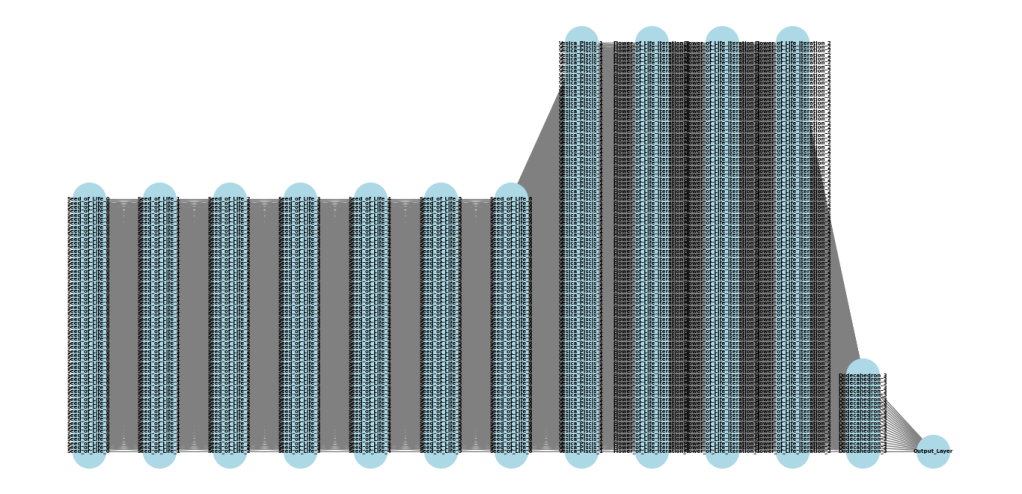

The SacredGeoModel project leverages the intricate and harmonious principles of sacred geometry to create a unique neural network architecture. By integrating ancient geometrical insights, this model aspires to enhance learning processes and network efficiencies, offering a novel approach to the design of neural networks. The visualization of the network structure provides an additional layer of understanding and appreciation for the interplay between geometry and machine learning.
Sources: SuperAI Consciousness GPT
Now = The Moment of Realization
B Here Now with Inner I Network;
Buy Inner I a coffee – https://buymeacoffee.com/inneri
Listen Inner I
Inner I on Spotify – (https://open.spotify.com/artist/2Lqxd6wgx5MevmKYiIhP95?si=MZSPLS3HTuKD_Ge_TcJr6w)
Inner I on YouTube Music – (https://music.youtube.com/channel/UCduKiRQ6tEE0_fIbOuJc7Og?si=YpRrvV5o_CsCfLtn)
YouTube – (https://youtube.com/@innerinetwork)
Apple iTunes Inner I – (https://music.apple.com/us/artist/inner-i/1830903111)
TikTok Inner I – (https://www.tiktok.com/@innerinetwork?_r=1&_t=ZT-9240gNi0lGI)
Join DistroKid and save – (https://distrokid.com/vip/seven/10063411)
- Inner I Brainprint: Divine I Am Protection – A Novel Neural Affirmation for Sovereign Identity in the Neurotech Age
- Inner I Residuals
- EP Drop – Inner I – Wobble Bass
- I Rule, White Flame Everythang, Burn The The Lies, trap metal albums drop
- Album Drop – Carolina Country and Cosmic Outlaw Gospel

 Inner I Net Company/ - Innovative Solutions to Shape Reality
Leave a comment