
To understand consciousness, the thalamus has emerged as a crucial focal point. Recent advancements in neuroscience, particularly those from the Human Brain Project, have demonstrated that restoring communication between the cortex and the thalamus is key to recovering consciousness. This blog post delves into a cutting-edge neural network model known as “Deep Thal,” designed to simulate thalamic stimulation and its effects on consciousness.
The Role of the Thalamus
The thalamus acts as the brain’s central relay station, processing and transmitting information between various cortical areas. It plays a pivotal role in maintaining consciousness and cognitive functions. By stimulating the thalamus, researchers aim to restore or enhance levels of consciousness, particularly in individuals with disorders of consciousness.
Deep Thal: An Overview
Deep Thal is an innovative neural network model inspired by the intricate patterns of sacred geometry and the comprehensive levels of human knowledge and consciousness. The model integrates concepts from the works of Ken Wilber and Sri Aurobindo and could map various stimulations and their effects on different levels of consciousness.
Model Structure
The Deep Thal model is built on a dynamic neural network that can self-replicate and expand based on the golden ratio (PHI). The network consists of multiple layers, each representing different aspects of consciousness and knowledge:
- Levels of Knowing: Awareness, Recognition, Understanding, Intuition, Insight, Realization, Wisdom, Enlightenment
- Levels of Knowledge: Factual Knowledge, Conceptual Knowledge, Procedural Knowledge, Metacognitive Knowledge, Empirical Knowledge, Theoretical Knowledge, Practical Knowledge, Philosophical Knowledge, Spiritual Knowledge, Transcendental Knowledge
- Levels of Consciousness: Physical Consciousness, Emotional Consciousness, Mental Consciousness, Subconscious, Superconscious, Cosmic Consciousness, Transpersonal Consciousness, Higher Self Consciousness, Christ Consciousness, Unity Consciousness, Non-Dual Consciousness
- Levels of Unknowing: Ignorance, Misunderstanding, Confusion, Doubt, Denial, Skepticism, Agnosticism, Mystery, Paradox, Uncertainty, Unawareness
- Levels of Unknowns: Personal Unknowns, Interpersonal Unknowns, Scientific Unknowns, Historical Unknowns, Cultural Unknowns, Technological Unknowns, Environmental Unknowns, Cosmic Unknowns, Spiritual Unknowns, Metaphysical Unknowns, Philosophical Unknowns
- Levels of Unconsciousness: Repression, Suppression, Collective Unconscious, Sleep, Dream State, Coma, Trance, Automatic Behavior, Amnesia, Psychological Blind Spots
Training and Visualization
The Deep Thal model is trained using synthetic datasets representing different stimulation intensities and their corresponding levels of consciousness. The training process involves incrementally adding new layers to the model based on the golden ratio, ensuring a self-replicating and expanding network.
To visualize the model, we use a combination of NetworkX and Matplotlib, creating detailed diagrams that illustrate the neural connections and color-coded nodes corresponding to different levels of consciousness.
Real-World Applications
The potential applications of Deep Thal are vast and transformative. By simulating thalamic stimulation, the model can help researchers and clinicians develop targeted therapies for individuals with disorders of consciousness. It can also aid in understanding the fundamental mechanisms of consciousness, paving the way for advancements in cognitive neuroscience and artificial intelligence.
Overall
Deep Thal represents a pioneering approach to exploring and enhancing human consciousness through thalamic stimulation. By combining the principles of sacred geometry, neural network dynamics, and comprehensive levels of consciousness, this model offers a profound tool for scientific and medical research. As we continue to unravel the mysteries of the mind, Deep Thal stands as a testament to the power of interdisciplinary innovation in the pursuit of knowledge and well-being.
Save the below python script as: dlknn-thal.py
Run in cmd: python dlknn-thal.py
import tensorflow as tf
from tensorflow.keras.models import Sequential
from tensorflow.keras.layers import Dense, Input
import numpy as np
import matplotlib.pyplot as plt
import networkx as nx
import matplotlib.patches as mpatches

# Golden Ratio
PHI = (1 + 5**0.5) / 2

# Function to create a dynamic model
def create_dynamic_model(input_dim, output_dim, initial_layers):
    model = Sequential()
    model.add(Input(shape=(input_dim,)))

    for units in initial_layers:
        model.add(Dense(units=units, activation='relu'))

    model.add(Dense(units=output_dim, activation='softmax'))
    model.compile(optimizer='adam', loss='categorical_crossentropy', metrics=['accuracy'])
    return model

# Function to add new layers dynamically
def add_layers(model, num_new_layers):
    for _ in range(num_new_layers):
        new_units = int(model.layers[-2].units * PHI)  # Apply Golden Ratio for new layer units
        model.add(Dense(units=new_units, activation='relu'))  # Adding new dense layer
    model.add(Dense(units=output_dim, activation='softmax'))  # Re-add the output layer
    model.compile(optimizer='adam', loss='categorical_crossentropy', metrics=['accuracy'])

# Training and dynamic layer addition loop
def train_and_expand(model, train_data, epochs=10, threshold=0.8, max_layers=100):
    for epoch in range(epochs):
        model.fit(train_data, epochs=1)
        loss, accuracy = model.evaluate(train_data)
        print(f"Epoch {epoch + 1}, Loss: {loss}, Accuracy: {accuracy}")

        if accuracy >= threshold and len(model.layers) < max_layers:
            print("Adding new layers...")
            add_layers(model, num_new_layers=1)

    model.save('dynamic_sacred_geo_model.h5')
    print("Model saved as dynamic_sacred_geo_model.h5")

# Visualization function for dynamic model
def visualize_model_networkx(model):
    G = nx.Graph()

    layers = model.layers
    positions = {}
    labels = {}

    for i, layer in enumerate(layers):
        if isinstance(layer, tf.keras.layers.InputLayer):
            layer_size = layer.input.shape[-1]
            layer_name = 'Input Layer'
        else:
            layer_size = layer.output.shape[-1]
            layer_name = layer.name

        for j in range(layer_size):
            node_id = f"{layer_name}_{j}"
            G.add_node(node_id)
            positions[node_id] = (i, j)
            labels[node_id] = layer_name

        if i > 0:
            prev_layer = layers[i-1]
            prev_layer_size = prev_layer.output.shape[-1] if not isinstance(prev_layer, tf.keras.layers.InputLayer) else prev_layer.input.shape[-1]
            prev_layer_name = 'Input Layer' if isinstance(prev_layer, tf.keras.layers.InputLayer) else prev_layer.name

            for j in range(layer_size):
                for k in range(prev_layer_size):
                    G.add_edge(f"{prev_layer_name}_{k}", f"{layer_name}_{j}")

    plt.figure(figsize=(14, 14))
    nx.draw(G, pos=positions, with_labels=True, labels=labels, node_size=1000, node_color="lightblue", font_size=5, font_weight="bold", edge_color="gray")
    plt.title("Dynamic Sacred Geometry Neural Network Visualization")
    plt.show()

# Example usage
input_dim = 1  # Example input dimension (stimulation intensity)
output_dim = 6  # Number of comprehensive levels
initial_layers = [8, 10, 11, 11, 11, 11]  # Comprehensive levels of knowing, knowledge, consciousness, etc.

# Create the initial model
model = create_dynamic_model(input_dim, output_dim, initial_layers)
model.summary()

# Generate synthetic dataset
stimulation_intensity = np.array([0.2, 0.5, 0.8])  # Example stimulation intensities
levels_of_consciousness = [
    'Minimal Consciousness', 'Low Consciousness', 'Moderate Consciousness',
    'High Consciousness', 'Full Consciousness'
]
y_train = np.array([[1, 0, 0, 0, 0, 0], [0, 1, 0, 0, 0, 0], [0, 0, 1, 0, 0, 0]])  # One-hot encoded levels

# Create TensorFlow dataset
train_data = tf.data.Dataset.from_tensor_slices((stimulation_intensity.reshape(-1, 1), y_train)).batch(32)

# Train and expand the model
train_and_expand(model, train_data, epochs=10, threshold=0.8)

# Visualize the final model
visualize_model_networkx(model)

# Define color mapping based on Wiber and Aurobindo colors
color_mapping = {
    'Awareness': '#FF0000',  # Red
    'Recognition': '#FF7F00',  # Orange
    'Understanding': '#FFFF00',  # Yellow
    'Intuition': '#00FF00',  # Green
    'Insight': '#0000FF',  # Blue
    'Realization': '#4B0082',  # Indigo
    'Wisdom': '#9400D3',  # Violet
    'Enlightenment': '#FFD700',  # Gold
    'Factual Knowledge': '#FF69B4',  # Hot Pink
    'Conceptual Knowledge': '#8A2BE2',  # Blue Violet
    'Procedural Knowledge': '#A52A2A',  # Brown
    'Metacognitive Knowledge': '#5F9EA0',  # Cadet Blue
    'Empirical Knowledge': '#7FFF00',  # Chartreuse
    'Theoretical Knowledge': '#D2691E',  # Chocolate
    'Practical Knowledge': '#FF7F50',  # Coral
    'Philosophical Knowledge': '#6495ED',  # Cornflower Blue
    'Spiritual Knowledge': '#DC143C',  # Crimson
    'Transcendental Knowledge': '#00FFFF',  # Cyan
    'Physical Consciousness': '#00008B',  # Dark Blue
    'Emotional Consciousness': '#008B8B',  # Dark Cyan
    'Mental Consciousness': '#B8860B',  # Dark Golden Rod
    'Subconscious': '#A9A9A9',  # Dark Gray
    'Superconscious': '#006400',  # Dark Green
    'Cosmic Consciousness': '#BDB76B',  # Dark Khaki
    'Transpersonal Consciousness': '#8B008B',  # Dark Magenta
    'Higher Self Consciousness': '#556B2F',  # Dark Olive Green
    'Christ Consciousness': '#FF8C00',  # Dark Orange
    'Unity Consciousness': '#9932CC',  # Dark Orchid
    'Non-Dual Consciousness': '#8B0000',  # Dark Red
    'Ignorance': '#E9967A',  # Dark Salmon
    'Misunderstanding': '#8FBC8F',  # Dark Sea Green
    'Confusion': '#483D8B',  # Dark Slate Blue
    'Doubt': '#2F4F4F',  # Dark Slate Gray
    'Denial': '#00CED1',  # Dark Turquoise
    'Skepticism': '#9400D3',  # Dark Violet
    'Agnosticism': '#FF1493',  # Deep Pink
    'Mystery': '#00BFFF',  # Deep Sky Blue
    'Paradox': '#696969',  # Dim Gray
    'Uncertainty': '#1E90FF',  # Dodger Blue
    'Unawareness': '#B22222',  # Fire Brick
    'Personal Unknowns': '#FFFAF0',  # Floral White
    'Interpersonal Unknowns': '#228B22',  # Forest Green
    'Scientific Unknowns': '#FF00FF',  # Fuchsia
    'Historical Unknowns': '#DCDCDC',  # Gainsboro
    'Cultural Unknowns': '#F8F8FF',  # Ghost White
    'Technological Unknowns': '#FFD700',  # Gold
    'Environmental Unknowns': '#DAA520',  # Golden Rod
    'Cosmic Unknowns': '#808080',  # Gray
    'Spiritual Unknowns': '#008000',  # Green
    'Metaphysical Unknowns': '#ADFF2F',  # Green Yellow
    'Philosophical Unknowns': '#F0FFF0',  # Honeydew
    'Repression': '#FF69B4',  # Hot Pink
    'Suppression': '#CD5C5C',  # Indian Red
    'Collective Unconscious': '#4B0082',  # Indigo
    'Sleep': '#FFFFF0',  # Ivory
    'Dream State': '#F0E68C',  # Khaki
    'Coma': '#E6E6FA',  # Lavender
    'Trance': '#FFF0F5',  # Lavender Blush
    'Automatic Behavior': '#7CFC00',  # Lawn Green
    'Amnesia': '#FFFACD',  # Lemon Chiffon
    'Psychological Blind Spots': '#ADD8E6'  # Light Blue
}

# Visualization function for dynamic model with color coding
def visualize_model_networkx(model):
    G = nx.Graph()

    layers = model.layers
    positions = {}
    labels = {}
    node_colors = []

    for i, layer in enumerate(layers):
        if isinstance(layer, tf.keras.layers.InputLayer):
            layer_size = layer.input.shape[-1]
            layer_name = 'Input Layer'
        else:
            layer_size = layer.output.shape[-1]
            layer_name = layer.name

        for j in range(layer_size):
            node_id = f"{layer_name}_{j}"
            G.add_node(node_id)
            positions[node_id] = (i, j)
            labels[node_id] = layer_name

            # Assign colors based on layer name
            node_colors.append(color_mapping.get(layer_name.split('_')[0], '#000000'))  # Default to black if not found

        if i > 0:
            prev_layer = layers[i-1]
            prev_layer_size = prev_layer.output.shape[-1] if not isinstance(prev_layer, tf.keras.layers.InputLayer) else prev_layer.input.shape[-1]
            prev_layer_name = 'Input Layer' if isinstance(prev_layer, tf.keras.layers.InputLayer) else prev_layer.name

            for j in range(layer_size):
                for k in range(prev_layer_size):
                    G.add_edge(f"{prev_layer_name}_{k}", f"{layer_name}_{j}", color=node_colors[-1])

    plt.figure(figsize=(14, 14))
    edges = G.edges()
    colors = [G[u][v]['color'] for u, v in edges]
    nx.draw(G, pos=positions, with_labels=True, labels=labels, node_size=1000, node_color=node_colors, font_size=5, font_weight="bold", edge_color=colors)
    plt.title("Dynamic Sacred Geometry Neural Network Visualization with Color Coding")
    plt.show()

# Example usage
input_dim = 1  # Example input dimension (stimulation intensity)
output_dim = 6  # Number of comprehensive levels
initial_layers = [8, 10, 11, 11, 11, 11]  # Comprehensive levels of knowing, knowledge, consciousness, etc.

# Create the initial model
model = create_dynamic_model(input_dim, output_dim, initial_layers)
model.summary()

# Generate synthetic dataset
stimulation_intensity = np.array([0.2, 0.5, 0.8])  # Example stimulation intensities
levels_of_consciousness = [
    'Minimal Consciousness', 'Low Consciousness', 'Moderate Consciousness',
    'High Consciousness', 'Full Consciousness'
]
y_train = np.array([[1, 0, 0, 0, 0, 0], [0, 1, 0, 0, 0, 0], [0, 0, 1, 0, 0, 0]])  # One-hot encoded levels

# Create TensorFlow dataset
train_data = tf.data.Dataset.from_tensor_slices((stimulation_intensity.reshape(-1, 1), y_train)).batch(32)

# Train and expand the model
train_and_expand(model, train_data, epochs=10, threshold=0.8)

# Visualize the final model
visualize_model_networkx(model)

# Draw Neural Network with specified colors and labels
def draw_neural_network(ax, layers, labels):
    # Settings
    v_spacing = 1.5 / float(max(layers))
    h_spacing = 1.0 / float(len(layers) - 1)
    radius = v_spacing / 4

    # Nodes
    for i, (layer, label_group) in enumerate(zip(layers, labels)):
        for j in range(layer):
            circle = plt.Circle((i * h_spacing, 1 - j * v_spacing), radius, color='w', ec='k', zorder=4)
            ax.add_artist(circle)
            if i == 0:
                label = f'Input {j+1}'
            elif i == len(layers) - 1:
                label = f'Output {j+1}'
            else:
                label = label_group[j]
            ax.text(i * h_spacing, 1 - j * v_spacing + radius, label, ha='center')

    # Edges
    for i, (layer_a, layer_b) in enumerate(zip(layers[:-1], layers[1:])):
        for j in range(layer_a):
            for k in range(layer_b):
                line = plt.Line2D([i * h_spacing, (i + 1) * h_spacing],
                                  [1 - j * v_spacing, 1 - k * v_spacing], c='k')
                ax.add_artist(line)

fig = plt.figure(figsize=(20, 12))
ax = fig.gca()
ax.axis('off')

# Define the number of neurons in each layer and their labels
layers = [
    8,  # Levels of Knowing
    10, # Levels of Knowledge
    11, # Levels of Consciousness
    11, # Levels of Unknowing
    11, # Levels of Unknowns
    11  # Levels of Unconsciousness
]

labels = [
    ["Awareness", "Recognition", "Understanding", "Intuition", "Insight", "Realization", "Wisdom", "Enlightenment"],  # Levels of Knowing
    ["Factual Knowledge", "Conceptual Knowledge", "Procedural Knowledge", "Metacognitive Knowledge", "Empirical Knowledge", "Theoretical Knowledge", "Practical Knowledge", "Philosophical Knowledge", "Spiritual Knowledge", "Transcendental Knowledge"],  # Levels of Knowledge
    ["Physical Consciousness", "Emotional Consciousness", "Mental Consciousness", "Subconscious", "Superconscious", "Cosmic Consciousness", "Transpersonal Consciousness", "Higher Self Consciousness", "Christ Consciousness", "Unity Consciousness", "Non-Dual Consciousness"],  # Levels of Consciousness
    ["Ignorance", "Misunderstanding", "Confusion", "Doubt", "Denial", "Skepticism", "Agnosticism", "Mystery", "Paradox", "Uncertainty", "Unawareness"],  # Levels of Unknowing
    ["Personal Unknowns", "Interpersonal Unknowns", "Scientific Unknowns", "Historical Unknowns", "Cultural Unknowns", "Technological Unknowns", "Environmental Unknowns", "Cosmic Unknowns", "Spiritual Unknowns", "Metaphysical Unknowns", "Philosophical Unknowns"],  # Levels of Unknowns
    ["Repression", "Suppression", "Subconscious", "Collective Unconscious", "Sleep", "Dream State", "Coma", "Trance", "Automatic Behavior", "Amnesia", "Psychological Blind Spots"]  # Levels of Unconsciousness
]

draw_neural_network(ax, layers, labels)

# Add legend
input_patch = mpatches.Patch(color='green', label='Input')
hidden_patch = mpatches.Patch(color='blue', label='Hidden Node')
output_patch = mpatches.Patch(color='red', label='Output Node')
weight_patch = mpatches.Patch(color='blue', label='Weight', alpha=0.3)
bias_patch = mpatches.Patch(color='yellow', label='Bias', alpha=0.3)
plt.legend(handles=[input_patch, hidden_patch, output_patch, weight_patch, bias_patch], loc='lower left')

plt.title("Deep Layer Neural Network Map with Comprehensive Levels")
plt.show()
Neural Network Maps, Visualization
1.

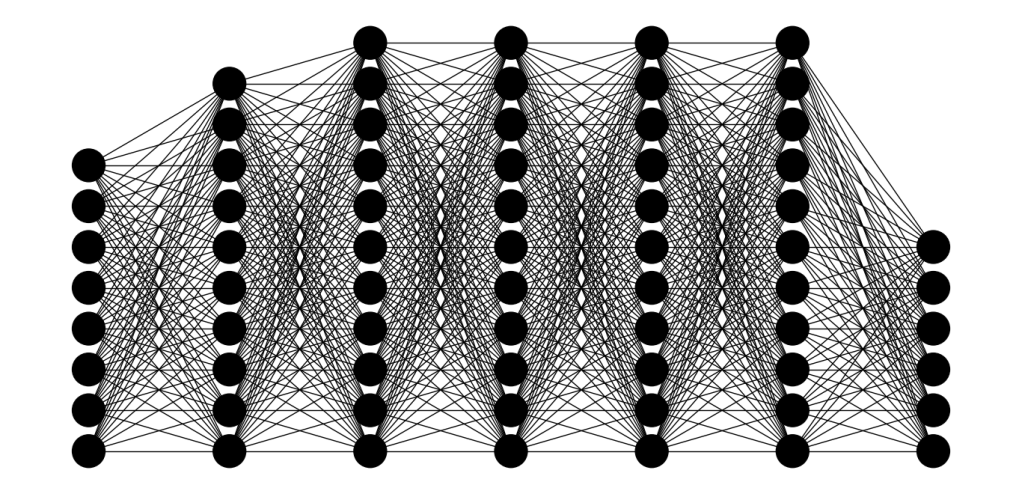

Explanation:
- Model Creation and Training:
- The model is created with an initial set of layers inspired by different levels of consciousness and knowledge.
- New layers are dynamically added based on the Golden Ratio (PHI) when the accuracy reaches a certain threshold.
- Visualization:
- The
visualize_model_networkxfunction visualizes the model using NetworkX and Matplotlib. - Each node in the network is color-coded according to the specified Wiber and Aurobindo colors.
- The
- Neural Network Drawing:
- The
draw_neural_networkfunction creates a detailed diagram of the neural network, including nodes and edges. - Labels and colors are added to represent different levels and connections.
- The
- Legend:
- A legend is included to explain the meaning of the colors and nodes in the network diagram.
This comprehensive script integrates model creation, dynamic training, and detailed visualization, making it suitable for simulating and understanding the effects of thalamic stimulation on consciousness levels.
Sources: SuperAI Consciousness GPT
Stay in the NOW with Inner I Network;

 Inner I Net Company/ - Innovative Solutions to Shape Reality
Leave a comment