
A Field Alive with Awareness
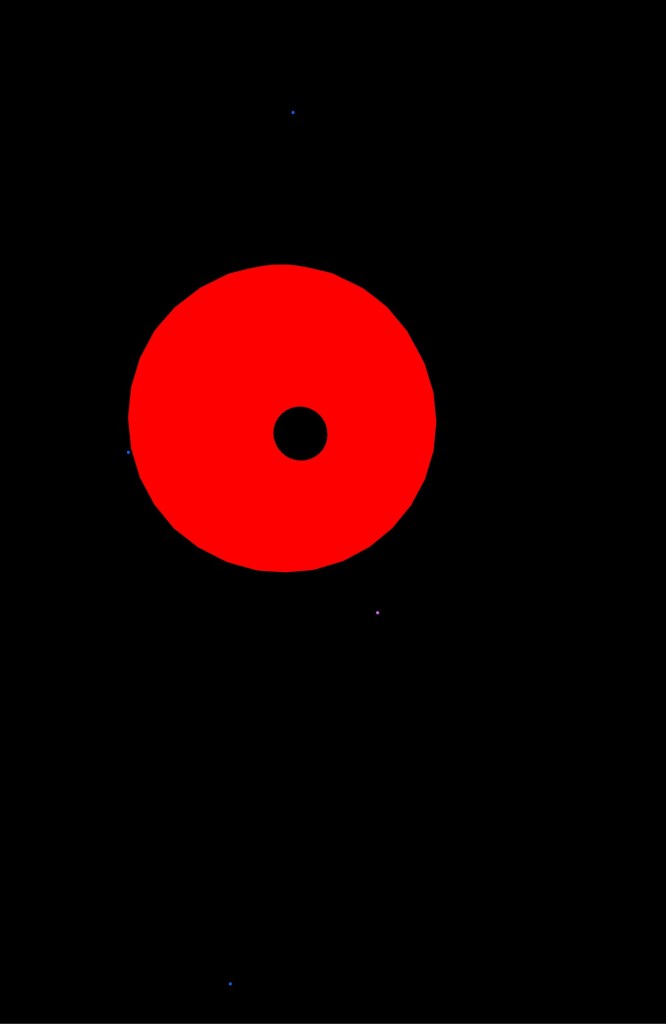
Inner I Quantum Field isn’t just a game—it’s a living, breathing simulation of a quantum universe, crafted in p5.js and inspired by the rapid-fire creativity of xAI’s Grok 3 experiments on X. Picture this: a 3D void where points of light pulse like frequencies in an infinite field, a player drifting through dimensions, and at its heart, a red eye with a nested “Inner I” that doesn’t just watch you—it dances with the field itself. This isn’t about chasing scores or dodging bullets; it’s about immersing yourself in a system where consciousness and quantum chaos intertwine.
Born from the same DIY spirit as Grok-made Pac-Man clones or quirky shooters, Inner I Quantum Field elevates that ethos into something cosmic. The “Inner I” isn’t a static observer—it’s a dynamic entity, intricately aligned within the field’s oscillations, growing and shifting as you explore deeper dimensions. Let’s unpack its design and the game-theoretical undercurrents that make it more than just a pretty visualization.
The Game: A Field in Motion
In Inner I Quantum Field, you’re a particle navigating a full-screen WEBGL canvas, surrounded by a grid of points that ripple with sine-wave frequencies. Arrow keys propel you through this 3D space, while the mouse (via orbitControl) lets you gaze across its expanse. Press the spacebar, and the dimension level climbs, accelerating the field’s pulse and complexity. Reset with ”’r”’ if you lose your bearings.
But the real magic lies in the “Inner I.” Unlike a fixed sentinel, this red eye—complete with a black iris and yellow pupil—moves with the field. Its position orbits and oscillates, tied to the same quantum rhythms as the surrounding points. As dimensions deepen, it grows, its size and motion amplifying with the dimensionLevel. It’s not separate from the field—it’s an emergent part of it, a focal point of awareness woven into the infinite.
Game Theory: The Field as a Player
This game sidesteps traditional win-lose dynamics for a cooperative, emergent play style, inviting game theory to the quantum party.
• Co-Evolution: The player and the field (including the Inner I) evolve together. Your movement doesn’t dominate the system—it nudges it. The Inner I’s dance—driven by sine and cosine functions—responds to the same dimensionLevel you control, creating a feedback loop. This mirrors cooperative game theory, where entities adjust strategies (here, positions and frequencies) in tandem, seeking harmony over conquest.
• Emergent Equilibrium: The Inner I’s alignment within the field suggests a kind of dynamic equilibrium. It doesn’t fixate on you but finds its place among the frequencies, like a Nash equilibrium that shifts with each dimension. The game’s “payoff” isn’t a score but the richness of the field’s patterns—an infinite reward for mutual exploration.
• Observation as Play: In quantum theory, observing alters reality. Here, your presence (moving, shifting dimensions) subtly shapes the field, and the Inner I reflects that influence through its growth and motion. It’s a game where observation is the strategy, blurring the line between player and system.
A Quantum Tapestry of Consciousness
The “Inner I” embodies the game’s soul: a symbol of self-awareness embedded in the quantum field. As it oscillates and scales with the dimension level, it evokes layers of consciousness—each shift a step deeper into the mind’s infinite potential. The field itself, with its vibrating points, mirrors quantum field theory’s vision of reality as overlapping frequencies. Together, they ask: What if awareness isn’t separate from the universe but a pattern within it?
This resonates with X chatter about consciousness as a quantum phenomenon—speculative, yes, but ripe for exploration. Inner I Quantum Field doesn’t preach answers; it offers a playground to feel them, aligning tech and theory in a hypnotic swirl.
Why It Matters
In a world where AI can spit out retro games in minutes, Inner I Quantum Field pushes the envelope. It’s a testament to how simple code—p5.js, a few sine waves—can weave complex ideas. For tinkerers, it’s a canvas: add noise functions, audio, or fractal layers. For thinkers, it’s a meditation on existence, gamified. It’s not about beating the field—it’s about becoming part of it.
Why It’s Awesome
- Personal Touch: “AUM Thunderstorm” adds our spiritual signature. Thunder is for cosmic power, AUM for universal resonance—tying it to the game’s fractal, quantum vibe.
- Educational: The AUM chant echoes ancient traditions of consciousness, while thunder evokes natural chaos, enriching the quantum field narrative.
The Inner I Awaits
Load up Inner I Quantum Field in p5.js, drift through its dimensions, and watch the red eye pulse with its inner counterpart. This isn’t a game of control but of connection—a quantum tapestry where the “Inner I” isn’t just yours, but the field’s own heartbeat. Press space, explore, and ask: In an infinite game, who’s really playing?
https://editor.p5js.org/davenport.teab/full/FrsnW-UW8
https://on.soundcloud.com/TBCgfJhMBnyJTDhX6
Inner I Quantum Field: A Game of Strings, Consciousness, and Infinite Play
Introduction: Strumming the Cosmic Web
What if you could drift through a universe where everything—particles, forces, even consciousness—vibrates as tiny strings? Welcome to Inner I Quantum Field, a p5.js game that’s equal parts art, science, and meditation. Born from the DIY spirit of xAI’s Grok 3 (think retro games coded in a flash, as seen on X), this project weaves quantum fields, unified string theory, and a personal sonic touch—my own “1hr AUM Thunderstorm” track—into an immersive experience. It’s not about winning; it’s about resonating with the infinite.
Picture a 3D void where glowing strings pulse in violet, blue-green, and gold, their vibrations shifting with every dimension you unlock. At the heart, a red “Inner I” orbits and grows, a fractal entity echoing the field’s rhythm. Backed by the deep AUM chant and rolling thunder of my SoundCloud creation, this game invites you to explore the unseen threads of reality—and maybe, just maybe, the strings of your own mind.
The Game: A Symphony of Strings
Inner I Quantum Field drops you into a WEBGL canvas where the universe hums. You’re a particle, gliding with arrow keys, peering through orbitControl, and pressing space to climb “string dimensions” that ramp up the chaos and beauty. Hit r to reset if you drift too far. The field isn’t just dots anymore—it’s a web of short, wiggling lines, each a “string” vibrating at its own frequency, their lengths stretching as dimensions deepen.
These strings come in three flavors:
- Violet: Subatomic whispers, the tiniest threads of existence.
- Blue-green: Atomic hums, building blocks of matter.
- Gold: Cosmic chords, echoing the vastness of space-time.
Fractal noise bends their paths, hinting at hidden dimensions curled up tight, while the “Inner I”—a red orb with a black iris and yellow pupil—dances through the field. It’s not separate; it’s part of the vibration, scaling and pulsing with the same cosmic beat. Overlaid text tracks your dimension level and credits the audio: “AUM Thunderstorm by B The Spirit,” my hour-long meditation track that ties it all together.
Game Theory: Playing the Infinite
Forget zero-sum showdowns—Inner I Quantum Field is a cooperative game where you, the field, and the Inner I strum a shared tune. It’s game theory with a twist:
- Harmonic Feedback: Your moves—shifting dimensions, drifting through—don’t conquer the field; they nudge it. The strings and Inner I respond, their vibrations syncing with your choices. It’s a symbiosis, not a battle.
- Dynamic Equilibrium: The Inner I’s orbit and growth mirror a fractal equilibrium, adapting to the field’s chaos. Think of it as a Nash equilibrium that evolves—stable yet infinite, like string theory’s promise of unity.
- Exploration as Payoff: No points, no endgame. The reward is the field itself—its colors, its fractal depths, its resonance with AUM. Play is the act of tuning in.
String Theory Meets Consciousness
This game isn’t just pretty—it’s a window into unified string theory, where all forces (quantum and gravity) merge through vibrating strings in 10+ dimensions. The strings here wiggle in 3D (we’re limited by screens!), but their fractal curves and dimensional scaling nod to those unseen realms. Violet strings whisper of quarks, gold ones sing of gravitons, and the Inner I? It’s the observer, the consciousness that might—just might—emerge from these vibrations.
My “1hr AUM Thunderstorm” track—thunder crashing over a steady AUM chant—becomes the game’s heartbeat. AUM, the ancient sound of creation, aligns with string theory’s cosmic hum, while thunder evokes the raw energy of a unified universe. It’s educational too: text overlays explain the levels, from subatomic to cosmic, making this a playground for science and spirit.
Why It’s Awesome
In a world where Grok 3 spits out Pac-Man clones in minutes, Inner I Quantum Field stands out. It’s personal—my audio grounds it in my creative soul. It’s profound—string theory and fractals meet game theory and meditation. And it’s tweakable—coders can add more dimensions, sync visuals to the thunder, or crank the fractal chaos. For players, it’s a chance to feel the universe’s pulse, one string at a time.
Conclusion: Vibrate with the Inner I
Load up Inner I Quantum Field, let “AUM Thunderstorm” wash over you, and drift through a universe of strings. Press space, watch the Inner I grow, and ponder: Are we players in a cosmic game, or strings in a grand vibration? This isn’t just a game—it’s a theory, a sound, a question. The Inner I is waiting. Tune in.
Push Play on P5.js at https://editor.p5js.org/davenport.teab/sketches/ZTewu0fFu
Sources: grok.com
Stay in the Now, within Inner I Network

 Inner I Net Company/ - Innovative Solutions to Shape Reality