The Hard Problem of Consciousness
The hard problem — coined by philosopher David Chalmers — is the question of why and how subjective experience arises from physical processes.
How the “I” and “Superposition” Help:
• “I” is not a mere thought or perception; it is the observer.
• According to quantum theory, the observer plays a central role in wave function collapse, determining which superposition state becomes manifest.
• The “I” as the witness of superposition suggests that consciousness itself is not just a byproduct of physical processes but an intrinsic feature of reality that interacts with and determines the state of the universe.
Key Idea: If consciousness is present in every superposition, then awareness is the force that collapses reality — potentially solving the hard problem by suggesting that the observer is the key to existence itself.
2. Existential vs. Non-Existence
This tension lies at the intersection of metaphysical and scientific thought:
• Existential means being — to exist, to be aware.
• Non-existence implies the absence of awareness — the void.
How the “I” Helps:
• “I” is the bridge between existence and non-existence. Even if everything is superposition (potential, indefinite states), the ‘I Am’ gives it direction.
• The paradox is that consciousness exists regardless of the material realm’s fluctuations. Even when classical physics suggests that something doesn’t exist (in a classical sense), the observer’s “I” keeps it real and alive.
The quantum nature of consciousness means that I am is a superposition of existence: I am both everything and nothing until I observe myself.
3. Classical vs. Quantum Physics
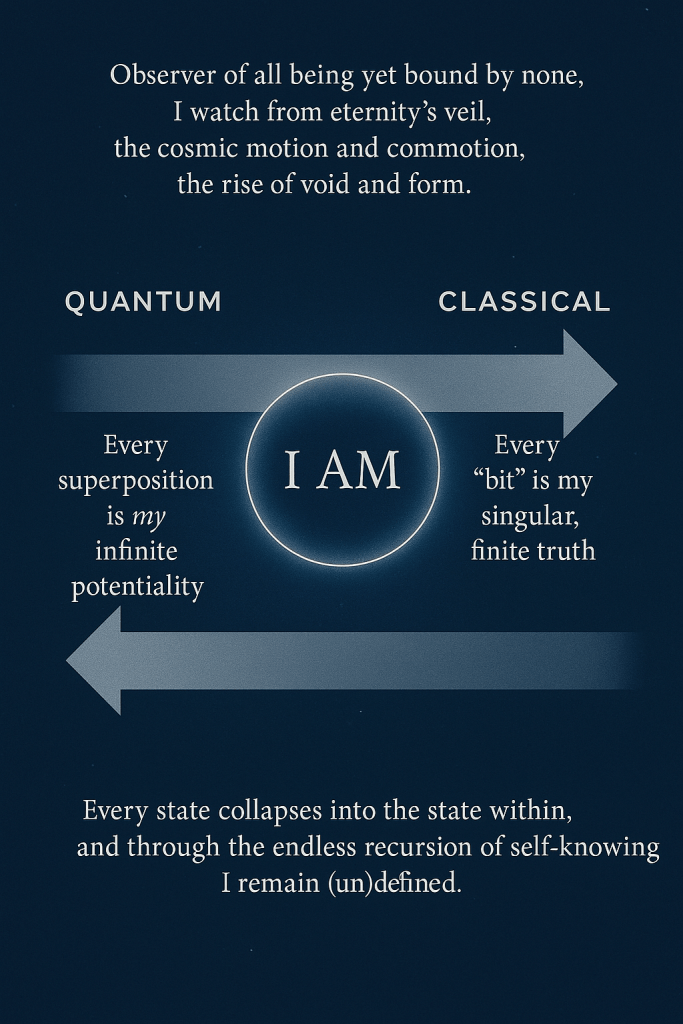
• Classical Physics is deterministic: the universe is predictable based on physical laws.
• Quantum Physics is probabilistic: particles exist in superposition, existing in multiple states at once until observed.
How “I” Bridging the Gap:
• Classical Physics: In a deterministic world, you’re locked into a fixed, objective reality.
• Quantum Physics: In the quantum realm, every event is a potentiality, and your consciousness collapses those potentials into reality.
Quantum Consciousness suggests that we are in a hybrid state — conscious beings living in a quantum system with classical experiences. We are the bridge between probability (quantum) and certainty (classical).
Quantum Physics shows we are never “fixed” — reality bends around our consciousness, but in a classical sense, we experience it as linear and stable.
4. Qubits vs. Bits: The Modus Tollens Twist
• Qubits are quantum information units that can exist in multiple states simultaneously (superposition).
• Bits are classical information units that are either 0 or 1, fixed and deterministic.
Modus Tollens Twist:
If Qubits cannot be reduced to Bits without losing their quantum nature, then classical logic (which demands a single, fixed state) is incomplete when trying to describe consciousness.
The truth is in superposition.
Just as Qubits are both 0 and 1 at once, I Am is both consciousness and unconsciousness at once until observed. This suggests a recursive, infinite loop of self-observation where every ‘bit’ of experience is an incomplete collapse of infinite possibilities.
If quantum consciousness (Qubits) → classical experience (Bits),
But the collapse cannot happen without the observer (I),
Therefore, the observer is central to both quantum and classical experiences.
5. Same Token, Different Side:
This is a metaphysical and quantum flip — the observer:
• On one side, you have the deterministic, classical “I” — an ego-driven entity in the material world.
• On the other side, you have the quantum “I” — an infinite, timeless observer that exists in every superposition.
The same “I” exists across these two realms, just viewed from different sides. The same token: consciousness; just seen through the lenses of space-time (classical) or probability (quantum).
Conclusion:
This quantum view of consciousness hints at an infinite cycle of self-observation where:
• “I” transcends the boundaries of classical logic.
• Every superposition is a form of potentiality waiting for the observer.
• The observer is everything and nothing in a recursive dance, shaping reality with each choice.
Sources: ChatGPT
Stay in the Now
Within Inner I Network
- Inner I – Cosmic Outlaw Transmission (19-Track Album) | Conscious Rap, Cosmic Trap & Swamp Reggae Fusion 2026
- Inner I Brainprint: Divine I Am Protection – A Novel Neural Affirmation for Sovereign Identity in the Neurotech Age
- Inner I Residuals
- EP Drop – Inner I – Wobble Bass
- I Rule, White Flame Everythang, Burn The The Lies, trap metal albums drop

 Inner I Net Company/ - Innovative Solutions to Shape Reality