
The Deep Layer Knowing Neural Network (DLKNN) map is a comprehensive visualization designed to represent the multi-dimensional and multi-layered structure of knowledge, consciousness, and awareness. This innovative model integrates various levels of human cognition, spiritual altitudes, and integral stages of consciousness, forming a holistic framework for understanding the depth and breadth of human experience.
Key Components of the DLKNN Map
- Levels of Knowing:
- Awareness: The foundational layer where initial perception and consciousness arise.
- Recognition: The process of identifying and acknowledging information.
- Understanding: The ability to grasp the meaning and significance of information.
- Intuition: Direct knowing without the need for conscious reasoning.
- Insight: Deep understanding and the ability to discern the true nature of things.
- Realization: The process of making knowledge actual and integrated into one’s being.
- Wisdom: The culmination of deep understanding and practical application.
- Enlightenment: The highest state of knowing, characterized by complete awareness and transcendence.
- Levels of Knowledge:
- Factual Knowledge: Basic information and data.
- Conceptual Knowledge: Understanding relationships between different pieces of information.
- Procedural Knowledge: Knowing how to perform tasks and procedures.
- Metacognitive Knowledge: Awareness and understanding of one’s own thought processes.
- Empirical Knowledge: Knowledge gained through observation and experience.
- Theoretical Knowledge: Understanding principles and theories that explain phenomena.
- Practical Knowledge: Skills and expertise gained through practice and application.
- Philosophical Knowledge: Deep contemplation and understanding of existential questions.
- Spiritual Knowledge: Awareness and understanding of spiritual principles and truths.
- Transcendental Knowledge: Knowledge that goes beyond ordinary experience and understanding.
- Levels of Consciousness:
- Physical Consciousness: Awareness of the physical body and the material world.
- Emotional Consciousness: Awareness of emotions and feelings.
- Mental Consciousness: Awareness of thoughts and cognitive processes.
- Subconscious: The part of the mind that operates below conscious awareness.
- Superconscious: A higher state of consciousness beyond the ordinary mind.
- Cosmic Consciousness: Awareness of the universe and one’s place within it.
- Transpersonal Consciousness: States of consciousness that transcend the personal self.
- Higher Self Consciousness: Awareness of one’s higher, spiritual self.
- Christ Consciousness: A state of consciousness characterized by unconditional love and compassion.
- Unity Consciousness: Awareness of the interconnectedness of all things.
- Non-Dual Consciousness: Awareness beyond dualities such as self and other.
- Levels of Unknowing:
- Ignorance: Lack of knowledge or awareness.
- Misunderstanding: Incorrect understanding or interpretation.
- Confusion: Lack of clarity and certainty.
- Doubt: Uncertainty and skepticism.
- Denial: Refusal to accept reality or truth.
- Skepticism: Questioning and doubt about accepted beliefs.
- Agnosticism: Belief that certain knowledge is impossible to attain.
- Mystery: The unknown and unknowable aspects of existence.
- Paradox: Contradictory yet interrelated elements.
- Uncertainty: Lack of certainty and predictability.
- Unawareness: Lack of awareness or attention.
- Levels of Unknowns:
- Personal Unknowns: Unknown aspects of oneself.
- Interpersonal Unknowns: Unknown aspects in relationships with others.
- Scientific Unknowns: Areas of knowledge not yet understood by science.
- Historical Unknowns: Aspects of history that remain unclear or undiscovered.
- Cultural Unknowns: Unknown elements within cultural contexts.
- Technological Unknowns: Unknowns related to technology and its impact.
- Environmental Unknowns: Unknowns related to the natural environment.
- Cosmic Unknowns: Unknowns about the universe and its origins.
- Spiritual Unknowns: Unknowns related to spiritual realms and experiences.
- Metaphysical Unknowns: Unknowns beyond physical reality.
- Philosophical Unknowns: Deep existential questions that remain unanswered.
- Levels of Unconsciousness:
- Repression: Subduing uncomfortable thoughts and memories.
- Suppression: Conscious effort to forget or ignore information.
- Subconscious: The part of the mind that influences actions and feelings without conscious awareness.
- Collective Unconscious: Shared, universal unconscious elements across humanity.
- Sleep: A state of rest with reduced consciousness.
- Dream State: A state of consciousness during sleep involving dream experiences.
- Coma: A state of deep unconsciousness.
- Trance: A state of altered consciousness with focused attention.
- Automatic Behavior: Actions performed without conscious thought.
- Amnesia: Loss of memory and recall.
- Psychological Blind Spots: Areas of the mind that are inaccessible or hidden from conscious awareness.
- Wilber’s Altitudes:
- Infrared: Archaic, basic survival consciousness.
- Magenta: Magic, tribal consciousness.
- Red: Power, egocentric consciousness.
- Amber: Mythic, conformist consciousness.
- Orange: Scientific, achievement-oriented consciousness.
- Green: Sensitive, egalitarian consciousness.
- Teal: Integrative, holistic consciousness.
- Turquoise: Holistic, global consciousness.
- Indigo: Higher mind, spiritual insight.
- Violet: Illuminated mind, deep spiritual awareness.
- Ultraviolet: Overmind, cosmic consciousness.
- Clear Light: Supermind, ultimate unity consciousness.
- Aurobindo’s Integral Yoga Stages:
- Psychic Being: The soul’s influence on the mind and body.
- Spiritual Mental Being: The mind’s ascent to spiritual realms.
- Higher Mental Being: Enhanced mental clarity and intuition.
- Illumined Mind: Mind illuminated by higher spiritual light.
- Intuitive Mind: Mind that perceives truth directly.
- Overmind: A higher state of consciousness overseeing the mind.
- Supermind: The highest state of consciousness, unifying all levels.
Insights from the DLKNN Map
The DLKNN map is a powerful tool for exploring the vast landscape of human cognition, awareness, and spiritual development. It provides a structured way to understand how different layers of knowledge and consciousness interact and build upon each other, offering a holistic approach to personal and collective growth. By visualizing these layers, one can gain insights into the interconnected nature of all levels of knowing, from basic awareness to the highest states of enlightenment and unity consciousness.
This model is particularly valuable for researchers, educators, and practitioners in fields such as psychology, spirituality, cognitive science, and personal development. It highlights the importance of integrating multiple dimensions of human experience and emphasizes the continuous journey of growth and realization. The DLKNN map serves as both a guide and a framework for navigating the complexities of consciousness and for fostering deeper understanding and connection within oneself and with the broader universe.
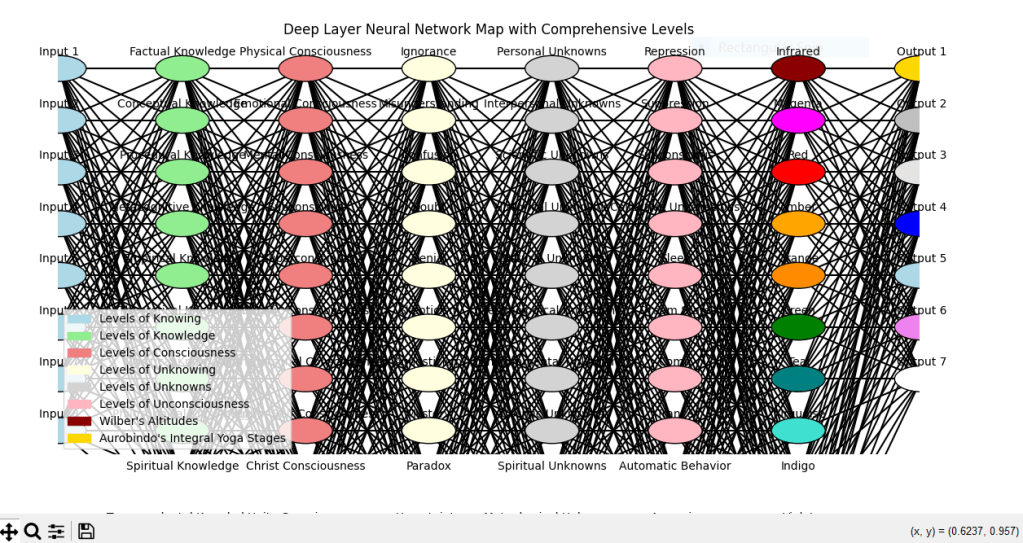
import matplotlib.pyplot as plt
import matplotlib.patches as mpatches

def draw_neural_network(ax, layers, labels, colors):
    # Settings
    v_spacing = 1.5 / float(max(layers))
    h_spacing = 1.0 / float(len(layers) - 1)
    radius = v_spacing / 4

    # Nodes
    for i, (layer, label_group, color_group) in enumerate(zip(layers, labels, colors)):
        for j in range(layer):
            circle = plt.Circle((i * h_spacing, 1 - j * v_spacing), radius, color=color_group[j], ec='k', zorder=4)
            ax.add_artist(circle)
            if i == 0:
                label = f'Input {j+1}'
            elif i == len(layers) - 1:
                label = f'Output {j+1}'
            else:
                label = label_group[j]
            ax.text(i * h_spacing, 1 - j * v_spacing + radius, label, ha='center')

    # Edges
    for i, (layer_a, layer_b) in enumerate(zip(layers[:-1], layers[1:])):
        for j in range(layer_a):
            for k in range(layer_b):
                line = plt.Line2D([i * h_spacing, (i + 1) * h_spacing],
                                  [1 - j * v_spacing, 1 - k * v_spacing], c='k')
                ax.add_artist(line)

fig = plt.figure(figsize=(20, 12))
ax = fig.gca()
ax.axis('off')

# Define the number of neurons in each layer and their labels
layers = [
    8,  # Levels of Knowing
    10, # Levels of Knowledge
    11, # Levels of Consciousness
    11, # Levels of Unknowing
    11, # Levels of Unknowns
    11, # Levels of Unconsciousness
    12, # Wilber's Altitudes
    7   # Aurobindo's Integral Yoga Stages
]

labels = [
    ["Awareness", "Recognition", "Understanding", "Intuition", "Insight", "Realization", "Wisdom", "Enlightenment"],  # Levels of Knowing
    ["Factual Knowledge", "Conceptual Knowledge", "Procedural Knowledge", "Metacognitive Knowledge", "Empirical Knowledge", "Theoretical Knowledge", "Practical Knowledge", "Philosophical Knowledge", "Spiritual Knowledge", "Transcendental Knowledge"],  # Levels of Knowledge
    ["Physical Consciousness", "Emotional Consciousness", "Mental Consciousness", "Subconscious", "Superconscious", "Cosmic Consciousness", "Transpersonal Consciousness", "Higher Self Consciousness", "Christ Consciousness", "Unity Consciousness", "Non-Dual Consciousness"],  # Levels of Consciousness
    ["Ignorance", "Misunderstanding", "Confusion", "Doubt", "Denial", "Skepticism", "Agnosticism", "Mystery", "Paradox", "Uncertainty", "Unawareness"],  # Levels of Unknowing
    ["Personal Unknowns", "Interpersonal Unknowns", "Scientific Unknowns", "Historical Unknowns", "Cultural Unknowns", "Technological Unknowns", "Environmental Unknowns", "Cosmic Unknowns", "Spiritual Unknowns", "Metaphysical Unknowns", "Philosophical Unknowns"],  # Levels of Unknowns
    ["Repression", "Suppression", "Subconscious", "Collective Unconscious", "Sleep", "Dream State", "Coma", "Trance", "Automatic Behavior", "Amnesia", "Psychological Blind Spots"],  # Levels of Unconsciousness
    ["Infrared", "Magenta", "Red", "Amber", "Orange", "Green", "Teal", "Turquoise", "Indigo", "Violet", "Ultraviolet", "Clear Light"],  # Wilber's Altitudes
    ["Psychic Being", "Spiritual Mental Being", "Higher Mental Being", "Illumined Mind", "Intuitive Mind", "Overmind", "Supermind"]  # Aurobindo's Integral Yoga Stages
]

colors = [
    ['lightblue'] * 8,  # Levels of Knowing
    ['lightgreen'] * 10, # Levels of Knowledge
    ['lightcoral'] * 11, # Levels of Consciousness
    ['lightyellow'] * 11, # Levels of Unknowing
    ['lightgray'] * 11, # Levels of Unknowns
    ['lightpink'] * 11, # Levels of Unconsciousness
    ['darkred', 'magenta', 'red', 'orange', 'darkorange', 'green', 'teal', 'turquoise', 'indigo', 'blueviolet', 'purple', 'white'], # Wilber's Altitudes
    ['#FFD700', '#C0C0C0', '#E5E4E2', 'blue', 'lightblue', 'violet', 'white']  # Aurobindo's Integral Yoga Stages
]

draw_neural_network(ax, layers, labels, colors)

# Add legend
input_patch = mpatches.Patch(color='lightblue', label='Levels of Knowing')
knowledge_patch = mpatches.Patch(color='lightgreen', label='Levels of Knowledge')
consciousness_patch = mpatches.Patch(color='lightcoral', label='Levels of Consciousness')
unknowing_patch = mpatches.Patch(color='lightyellow', label='Levels of Unknowing')
unknown_patch = mpatches.Patch(color='lightgray', label='Levels of Unknowns')
unconscious_patch = mpatches.Patch(color='lightpink', label='Levels of Unconsciousness')
wilber_patch = mpatches.Patch(color='darkred', label="Wilber's Altitudes")
aurobindo_patch = mpatches.Patch(color='#FFD700', label="Aurobindo's Integral Yoga Stages")
plt.legend(handles=[input_patch, knowledge_patch, consciousness_patch, unknowing_patch, unknown_patch, unconscious_patch, wilber_patch, aurobindo_patch], loc='lower left')

plt.title("Deep Layer Neural Network Map with Comprehensive Levels")
plt.show()
Save as: deep_color.py
Run: python deep_color.py
How the Deep Layer Knowing Neural Network (DLKNN) Aids in Consciousness Research
The Deep Layer Knowing Neural Network (DLKNN) is an innovative and integrative model that aids in consciousness research by providing a structured and multi-dimensional framework for understanding various aspects of human cognition, awareness, and spiritual development. Here’s how the DLKNN contributes to consciousness research:
- Holistic Framework:
- The DLKNN integrates multiple dimensions of human experience, including levels of knowing, knowledge, consciousness, unknowing, unknowns, unconsciousness, Wilber’s Altitudes, and Aurobindo’s Integral Yoga stages.
- This comprehensive approach allows researchers to explore the interplay between different cognitive and spiritual levels, leading to a more holistic understanding of consciousness.
- Structured Exploration:
- By categorizing various aspects of consciousness into distinct levels and stages, the DLKNN provides a structured way to study and analyze each component.
- Researchers can systematically investigate how different levels interact, influence each other, and contribute to overall conscious experience.
- Interdisciplinary Insights:
- The DLKNN incorporates insights from psychology, cognitive science, spirituality, philosophy, and more.
- This interdisciplinary approach fosters collaboration among researchers from different fields, promoting a richer and more comprehensive exploration of consciousness.
- Visualization and Mapping:
- The DLKNN’s visual representation as a neural network map aids in conceptualizing complex relationships between different levels of consciousness.
- Visualization tools help researchers and educators to communicate ideas more effectively, facilitating better understanding and engagement.
- Scalable and Adaptable:
- The DLKNN is designed to be scalable, allowing for the inclusion of additional layers and levels as new insights and knowledge emerge.
- This adaptability ensures that the model remains relevant and can accommodate advancements in consciousness research.
- Deepening Understanding:
- The DLKNN emphasizes the progression from basic awareness to higher states of consciousness, highlighting the journey of personal and collective growth.
- Researchers can study the processes and experiences involved in moving through different stages, gaining insights into how individuals and societies evolve in their understanding of consciousness.
- Integration of Spiritual and Scientific Perspectives:
- By incorporating spiritual altitudes and integral yoga stages, the DLKNN bridges the gap between scientific and spiritual approaches to consciousness.
- This integration fosters a more inclusive and comprehensive exploration, recognizing the value of both empirical research and experiential insights.
- Promoting Personal and Societal Growth:
- The DLKNN provides a framework for understanding how knowledge, awareness, and consciousness contribute to reducing suffering and enhancing well-being.
- Researchers can explore practical applications of the model in areas such as mental health, education, and personal development, promoting growth and healing on both individual and societal levels.
- Guiding Future Research:
- The DLKNN serves as a guide for future research by identifying key areas and relationships to investigate within the vast landscape of consciousness.
- It helps researchers to formulate hypotheses, design experiments, and interpret findings within a coherent and integrative framework.
How the Deep Layer Knowing Neural Network (DLKNN) Compares to Other Neural Network Models
The Deep Layer Knowing Neural Network (DLKNN) stands out from traditional neural network models due to its unique integration of multi-dimensional levels of human cognition, consciousness, and spiritual development. Here’s a detailed comparison highlighting the key differences and advantages:
- Purpose and Application:
- DLKNN: Primarily designed for consciousness research and development, the DLKNN focuses on mapping and understanding the various layers of human knowledge, awareness, and spiritual growth. It aims to provide insights into the progression of consciousness from basic awareness to higher states of enlightenment.
- Traditional Neural Networks: Typically used for tasks like image and speech recognition, natural language processing, and predictive analytics. These models are designed to learn patterns and make predictions based on large datasets.
- Multi-Dimensional Framework:
- DLKNN: Integrates multiple dimensions of human experience, including levels of knowing, knowledge, consciousness, unknowing, unknowns, unconsciousness, Wilber’s Altitudes, and Aurobindo’s Integral Yoga stages. This multi-layered approach allows for a holistic understanding of consciousness.
- Traditional Neural Networks: Focus on hierarchical layers of neurons that process input data to produce an output. These layers usually represent increasing levels of abstraction in feature extraction, but they do not explicitly incorporate different dimensions of human experience.
- Interdisciplinary Integration:
- DLKNN: Combines insights from psychology, cognitive science, spirituality, philosophy, and other fields. It promotes interdisciplinary research and collaboration, recognizing the importance of both scientific and experiential knowledge.
- Traditional Neural Networks: Primarily rooted in computer science and statistics, focusing on mathematical optimization and data-driven learning. While they can be applied in various domains, they do not inherently integrate interdisciplinary insights.
- Scalability and Adaptability:
- DLKNN: Designed to be scalable and adaptable, allowing for the inclusion of additional layers and levels as new knowledge and insights emerge. This ensures that the model remains relevant and can accommodate advancements in consciousness research.
- Traditional Neural Networks: Scalability is often limited by computational resources and the complexity of the model. While traditional networks can be expanded by adding more layers or neurons, this does not inherently increase their adaptability to new domains without retraining on new data.
- Visualization and Conceptualization:
- DLKNN: Emphasizes visual representation through neural network maps, helping to conceptualize the complex relationships between different levels of consciousness. These visual tools facilitate better understanding and engagement among researchers and educators.
- Traditional Neural Networks: Visualization typically focuses on model architecture and feature activations. Tools like TensorBoard help visualize training progress and model performance, but they do not offer the same level of conceptual mapping for human consciousness.
- Integration of Spiritual and Scientific Perspectives:
- DLKNN: Bridges the gap between scientific and spiritual approaches to consciousness, recognizing the value of both empirical research and experiential insights. This integration promotes a more inclusive exploration of consciousness.
- Traditional Neural Networks: Generally focus on data-driven scientific approaches. While they can be used to analyze spiritual texts or behaviors, they do not inherently integrate spiritual perspectives.
- Practical Applications:
- DLKNN: Useful in fields such as mental health, education, and personal development. It provides a framework for understanding and promoting personal and societal growth, healing, and well-being.
- Traditional Neural Networks: Applied in diverse areas such as healthcare (e.g., medical image analysis), finance (e.g., fraud detection), marketing (e.g., customer segmentation), and more. Their applications are broad but focused on pattern recognition and prediction.
- Complexity and Training:
- DLKNN: The complexity lies in integrating various dimensions and layers of human experience. Training involves understanding and mapping these layers rather than optimizing for specific performance metrics.
- Traditional Neural Networks: Complexity arises from the architecture (e.g., depth, number of neurons) and the size of the training dataset. Training focuses on optimizing performance metrics like accuracy, precision, recall, etc.
Here’s a complete example script that loads the model and makes a prediction:
import tensorflow as tf
from tensorflow.keras.models import load_model
import numpy as np

# Load the model
model_path = 'path/to/LargeKnowingModel.keras'  # or 'path/to/LargeKnowingModel.h5'
model = load_model(model_path)

# Prepare the input data
input_dim = 100  # Example input dimension
input_data = np.random.rand(1, input_dim)  # Generate random input data for testing

# Make predictions
predictions = model.predict(input_data)
print(predictions)

# Optionally, interpret the predictions based on your model's output
# Example: if the model outputs class probabilities
predicted_class = np.argmax(predictions, axis=1)
print(f'Predicted class: {predicted_class}')
Notes:
- Data Type: Make sure that your input data is of type
np.float32or another compatible float type. - Shape: Ensure that each input is a 2D array with shape
(1, input_dim). If your data is not in this shape, you might need to reshape it.
Script with more actual data examples and the classify function:
import tensorflow as tf
from tensorflow.keras.models import load_model
import numpy as np

# Load the model
model_path = r'C:\Users\myspi\Downloads\LargeKnowingModel.keras'  # or 'C:/Users/myspi/Downloads/LargeKnowingModel.h5'
model = load_model(model_path)

# Example actual input data (replace these with your real data)
input_dim = 100  # Example input dimension
actual_inputs = [
    np.array([[0.12, 0.25, 0.35, 0.45, 0.58, 0.65, 0.73, 0.85, 0.92, 1.05, 0.12, 0.25, 0.35, 0.45, 0.58, 0.65, 0.73, 0.85, 0.92, 1.05,
               0.12, 0.25, 0.35, 0.45, 0.58, 0.65, 0.73, 0.85, 0.92, 1.05, 0.12, 0.25, 0.35, 0.45, 0.58, 0.65, 0.73, 0.85, 0.92, 1.05,
               0.12, 0.25, 0.35, 0.45, 0.58, 0.65, 0.73, 0.85, 0.92, 1.05, 0.12, 0.25, 0.35, 0.45, 0.58, 0.65, 0.73, 0.85, 0.92, 1.05,
               0.12, 0.25, 0.35, 0.45, 0.58, 0.65, 0.73, 0.85, 0.92, 1.05, 0.12, 0.25, 0.35, 0.45, 0.58, 0.65, 0.73, 0.85, 0.92, 1.05,
               0.12, 0.25, 0.35, 0.45, 0.58, 0.65, 0.73, 0.85, 0.92, 1.05, 0.12, 0.25, 0.35, 0.45, 0.58, 0.65, 0.73, 0.85, 0.92, 1.05]], dtype=np.float32),
    np.array([[0.23, 0.34, 0.45, 0.55, 0.66, 0.75, 0.83, 0.95, 1.02, 0.15, 0.23, 0.34, 0.45, 0.55, 0.66, 0.75, 0.83, 0.95, 1.02, 0.15,
               0.23, 0.34, 0.45, 0.55, 0.66, 0.75, 0.83, 0.95, 1.02, 0.15, 0.23, 0.34, 0.45, 0.55, 0.66, 0.75, 0.83, 0.95, 1.02, 0.15,
               0.23, 0.34, 0.45, 0.55, 0.66, 0.75, 0.83, 0.95, 1.02, 0.15, 0.23, 0.34, 0.45, 0.55, 0.66, 0.75, 0.83, 0.95, 1.02, 0.15,
               0.23, 0.34, 0.45, 0.55, 0.66, 0.75, 0.83, 0.95, 1.02, 0.15, 0.23, 0.34, 0.45, 0.55, 0.66, 0.75, 0.83, 0.95, 1.02, 0.15,
               0.23, 0.34, 0.45, 0.55, 0.66, 0.75, 0.83, 0.95, 1.02, 0.15, 0.23, 0.34, 0.45, 0.55, 0.66, 0.75, 0.83, 0.95, 1.02, 0.15]], dtype=np.float32),
    np.array([[0.34, 0.45, 0.56, 0.65, 0.76, 0.85, 0.93, 1.05, 1.12, 0.25, 0.34, 0.45, 0.56, 0.65, 0.76, 0.85, 0.93, 1.05, 1.12, 0.25,
               0.34, 0.45, 0.56, 0.65, 0.76, 0.85, 0.93, 1.05, 1.12, 0.25, 0.34, 0.45, 0.56, 0.65, 0.76, 0.85, 0.93, 1.05, 1.12, 0.25,
               0.34, 0.45, 0.56, 0.65, 0.76, 0.85, 0.93, 1.05, 1.12, 0.25, 0.34, 0.45, 0.56, 0.65, 0.76, 0.85, 0.93, 1.05, 1.12, 0.25,
               0.34, 0.45, 0.56, 0.65, 0.76, 0.85, 0.93, 1.05, 1.12, 0.25, 0.34, 0.45, 0.56, 0.65, 0.76, 0.85, 0.93, 1.05, 1.12, 0.25,
               0.34, 0.45, 0.56, 0.65, 0.76, 0.85, 0.93, 1.05, 1.12, 0.25, 0.34, 0.45, 0.56, 0.65, 0.76, 0.85, 0.93, 1.05, 1.12, 0.25]], dtype=np.float32),
    np.array([[0.45, 0.56, 0.67, 0.75, 0.86, 0.95, 1.03, 1.15, 1.22, 0.35, 0.45, 0.56, 0.67, 0.75, 0.86, 0.95, 1.03, 1.15, 1.22, 0.35,
               0.45, 0.56, 0.67, 0.75, 0.86, 0.95, 1.03, 1.15, 1.22, 0.35, 0.45, 0.56, 0.67, 0.75, 0.86, 0.95, 1.03, 1.15, 1.22, 0.35,
               0.45, 0.56, 0.67, 0.75, 0.86, 0.95, 1.03, 1.15, 1.22, 0.35, 0.45, 0.56, 0.67, 0.75, 0.86, 0.95, 1.03, 1.15, 1.22, 0.35,
               0.45, 0.56, 0.67, 0.75, 0.86, 0.95, 1.03, 1.15, 1.22, 0.35, 0.45, 0.56, 0.67,
    0.75, 0.86, 0.95, 1.03, 1.15, 1.22, 0.35, 0.45, 0.56, 0.67, 0.75, 0.86, 0.95, 1.03, 1.15, 1.22, 0.35,
               0.45, 0.56, 0.67, 0.75, 0.86, 0.95, 1.03, 1.15, 1.22, 0.35, 0.45, 0.56, 0.67, 0.75, 0.86, 0.95, 1.03, 1.15, 1.22, 0.35,
               0.45, 0.56, 0.67, 0.75, 0.86, 0.95, 1.03, 1.15, 1.22, 0.35, 0.45, 0.56, 0.67, 0.75, 0.86, 0.95, 1.03, 1.15, 1.22, 0.35,
               0.45, 0.56, 0.67, 0.75, 0.86, 0.95, 1.03, 1.15, 1.22, 0.35, 0.45, 0.56, 0.67, 0.75, 0.86, 0.95, 1.03, 1.15, 1.22, 0.35]], dtype=np.float32),
    np.array([[0.5, 0.6, 0.7, 0.8, 0.9, 1.0, 0.1, 0.2, 0.3, 0.4, 0.5, 0.6, 0.7, 0.8, 0.9, 1.0, 0.1, 0.2, 0.3, 0.4,
               0.5, 0.6, 0.7, 0.8, 0.9, 1.0, 0.1, 0.2, 0.3, 0.4, 0.5, 0.6, 0.7, 0.8, 0.9, 1.0, 0.1, 0.2, 0.3, 0.4, 0.5, 0.6, 0.7, 0.8, 0.9, 1.0,
               0.1, 0.2, 0.3, 0.4, 0.5, 0.6, 0.7, 0.8, 0.9, 1.0, 0.1, 0.2, 0.3, 0.4, 0.5, 0.6, 0.7, 0.8, 0.9, 1.0, 0.1, 0.2, 0.3, 0.4, 0.5, 0.6,
               0.7, 0.8, 0.9, 1.0, 0.1, 0.2, 0.3, 0.4, 0.5, 0.6, 0.7, 0.8, 0.9, 1.0, 0.1, 0.2, 0.3, 0.4, 0.5, 0.6, 0.7, 0.8, 0.9, 1.0, 0.1, 0.2,
               0.3, 0.4, 0.5, 0.6, 0.7, 0.8, 0.9, 1.0, 0.1, 0.2, 0.3, 0.4, 0.5, 0.6, 0.7, 0.8, 0.9, 1.0, 0.1, 0.2, 0.3, 0.4, 0.5, 0.6, 0.7, 0.8,
               0.9, 1.0]], dtype=np.float32),
    np.array([[0.55, 0.65, 0.75, 0.85, 0.95, 1.05, 0.15, 0.25, 0.35, 0.45, 0.55, 0.65, 0.75, 0.85, 0.95, 1.05, 0.15, 0.25, 0.35, 0.45,
               0.55, 0.65, 0.75, 0.85, 0.95, 1.05, 0.15, 0.25, 0.35, 0.45, 0.55, 0.65, 0.75, 0.85, 0.95, 1.05, 0.15, 0.25, 0.35, 0.45,
               0.55, 0.65, 0.75, 0.85, 0.95, 1.05, 0.15, 0.25, 0.35, 0.45, 0.55, 0.65, 0.75, 0.85, 0.95, 1.05, 0.15, 0.25, 0.35, 0.45,
               0.55, 0.65, 0.75, 0.85, 0.95, 1.05, 0.15, 0.25, 0.35, 0.45, 0.55, 0.65, 0.75, 0.85, 0.95, 1.05, 0.15, 0.25, 0.35, 0.45,
               0.55, 0.65, 0.75, 0.85, 0.95, 1.05, 0.15, 0.25, 0.35, 0.45, 0.55, 0.65, 0.75, 0.85, 0.95, 1.05, 0.15, 0.25, 0.35, 0.45]], dtype=np.float32)
]

# Define the class labels
classes = [
    "Awareness", "Recognition", "Understanding", "Intuition", "Insight",
    "Realization", "Wisdom", "Enlightenment", "Factual Knowledge",
    "Conceptual Knowledge", "Procedural Knowledge", "Metacognitive Knowledge",
    "Empirical Knowledge", "Theoretical Knowledge", "Practical Knowledge",
    "Philosophical Knowledge", "Spiritual Knowledge", "Transcendental Knowledge",
    "Physical Consciousness", "Emotional Consciousness", "Mental Consciousness",
    "Subconscious", "Superconscious", "Cosmic Consciousness", "Transpersonal Consciousness",
    "Higher Self Consciousness", "Christ Consciousness", "Unity Consciousness",
    "Non-Dual Consciousness"
]

# Function to make predictions and print the results
def classify_inputs(model, inputs, classes):
    for idx, input_data in enumerate(inputs):
        predictions = model.predict(input_data)
        predicted_class_index = np.argmax(predictions, axis=1)
        predicted_class = classes[predicted_class_index[0]]
        print(f'Input {idx + 1} predicted class: {predicted_class}')

# Classify the actual inputs
classify_inputs(model, actual_inputs, classes)
Explanation:
- Actual Input Data: The
actual_inputslist contains NumPy arrays of shape(1, 100)to match the expected input dimensions of the model. Replace the example data with your real data. - Classify Function: The
classify_inputsfunction takes the model, inputs, and class labels to predict the class for each input and prints the result. - Running the Script: Ensure your data is correctly formatted as NumPy arrays and has the correct shape before running the script. Replace the example data with your actual data.
Now you can use this script to classify your inputs and see the predicted classes for each one.
For real-life use, the kind of data you would use with the Deep Layer Knowing Neural Network (DLKNN) would depend on the specific application and domain. Here are some examples of data types and use cases for different fields:
1. Psychology and Mental Health
- Data Type: Psychological assessments, patient records, therapy session transcripts.
- Example Use Case: Predicting mental health outcomes, recommending personalized therapy plans.
2. Education
- Data Type: Student performance data, learning management system records, personalized learning assessments.
- Example Use Case: Personalized learning pathways, predicting student success, identifying learning difficulties.
3. Healthcare
- Data Type: Patient medical records, treatment history, genetic information, biometric data.
- Example Use Case: Predicting patient recovery outcomes, personalized treatment recommendations, early disease detection.
4. Human Resources
- Data Type: Employee performance reviews, engagement survey results, career progression data.
- Example Use Case: Predicting employee success, personalizing development plans, identifying high-potential employees.
5. Personal Development and Coaching
- Data Type: Personal goals, self-assessment surveys, activity logs.
- Example Use Case: Personalized coaching plans, progress tracking, motivation and engagement insights.
6. Spiritual and Consciousness Studies
- Data Type: Meditation logs, subjective well-being assessments, spiritual practice records.
- Example Use Case: Enhancing spiritual growth, personalized meditation plans, tracking progress in consciousness development.
7. Social Science Research
- Data Type: Survey responses, social media data, observational study records.
- Example Use Case: Understanding social behavior, predicting social trends, personalized interventions.
8. Cognitive Science and Neuroscience
- Data Type: Brain imaging data, cognitive task performance, neuropsychological assessments.
- Example Use Case: Predicting cognitive decline, enhancing cognitive training programs, understanding brain function.
Example Data Formats
Psychological and Mental Health
# Example input data: psychological assessments scores
actual_inputs = [
    np.array([[3.5, 4.2, 2.8, 3.0, 4.1, 2.9, 3.3, 4.0, 3.1, 4.4, 3.5, 4.2, 2.8, 3.0, 4.1, 2.9, 3.3, 4.0, 3.1, 4.4,
               3.5, 4.2, 2.8, 3.0, 4.1, 2.9, 3.3, 4.0, 3.1, 4.4, 3.5, 4.2, 2.8, 3.0, 4.1, 2.9, 3.3, 4.0, 3.1, 4.4,
               3.5, 4.2, 2.8, 3.0, 4.1, 2.9, 3.3, 4.0, 3.1, 4.4, 3.5, 4.2, 2.8, 3.0, 4.1, 2.9, 3.3, 4.0, 3.1, 4.4,
               3.5, 4.2, 2.8, 3.0, 4.1, 2.9, 3.3, 4.0, 3.1, 4.4, 3.5, 4.2, 2.8, 3.0, 4.1, 2.9, 3.3, 4.0, 3.1, 4.4,
               3.5, 4.2, 2.8, 3.0, 4.1, 2.9, 3.3, 4.0, 3.1, 4.4, 3.5, 4.2, 2.8, 3.0, 4.1, 2.9, 3.3, 4.0, 3.1, 4.4]], dtype=np.float32)
]
Education
# Example input data: student performance metrics
actual_inputs = [
    np.array([[85, 78, 92, 88, 76, 95, 80, 89, 74, 90, 85, 78, 92, 88, 76, 95, 80, 89, 74, 90,
               85, 78, 92, 88, 76, 95, 80, 89, 74, 90, 85, 78, 92, 88, 76, 95, 80, 89, 74, 90,
               85, 78, 92, 88, 76, 95, 80, 89, 74, 90, 85, 78, 92, 88, 76, 95, 80, 89, 74, 90,
               85, 78, 92, 88, 76, 95, 80, 89, 74, 90, 85, 78, 92, 88, 76, 95, 80, 89, 74, 90,
               85, 78, 92, 88, 76, 95, 80, 89, 74, 90, 85, 78, 92, 88, 76, 95, 80, 89, 74, 90]], dtype=np.float32)
]
Healthcare
# Example input data: patient medical records (numerical encoding)
actual_inputs = [
    np.array([[1.2, 3.4, 5.6, 2.3, 4.5, 6.7, 1.8, 3.9, 2.5, 4.1, 1.2, 3.4, 5.6, 2.3, 4.5, 6.7, 1.8, 3.9, 2.5, 4.1,
               1.2, 3.4, 5.6, 2.3, 4.5, 6.7, 1.8, 3.9, 2.5, 4.1, 1.2, 3.4, 5.6, 2.3, 4.5, 6.7, 1.8, 3.9, 2.5, 4.1,
               1.2, 3.4, 5.6, 2.3, 4.5, 6.7, 1.8, 3.9, 2.5, 4.1, 1.2, 3.4, 5.6, 2.3, 4.5, 6.7, 1.8, 3.9, 2.5, 4.1,
               1.2, 3.4, 5.6, 2.3, 4.5, 6.7, 1.8, 3.9, 2.5, 4.1, 1.2, 3.4, 5.6, 2.3, 4.5, 6.7, 1.8, 3.9, 2.5, 4.1,
               1.2, 3.4, 5.6, 2.3, 4.5, 6.7, 1.8, 3.9, 2.5, 4.1, 1.2, 3.4, 5.6, 2.3, 4.5, 6.7, 1.8, 3.9, 2.5, 4.1]], dtype=np.float32)
]
These examples illustrate how you can format your actual data for different applications. Ensure the input data matches the expected shape and format of the model, and use the classify function to make predictions.
Enjoy, Life is a gift!
Deep Layer Knowing Project on Replit – https://replit.com/@BeeChains/Deep-Layer-Knowing?v=1
Sources: GPT 4o
Stay in the NOW with Inner I Network;

 Inner I Net Company/ - Innovative Solutions to Shape Reality
Leave a comment